
What Is a Qubit? A Developer's Explanation
Qubits are usually introduced with a claim that sounds remarkable and is subtly wrong: that a qubit is 0 and 1 at the same time, so a quantum computer tries all possible answers simultaneously.
The first half is a rough approximation. The second half does not follow from it, and believing it makes the rest of quantum computing impossible to understand — because if you could simply read all the answers, quantum algorithms would be trivial rather than the subject of decades of difficult research.
A more useful definition:
A qubit is the basic unit of quantum information: a two-state quantum system whose state before measurement is described by a continuous combination of 0 and 1, but which yields exactly one classical bit when measured.
The tension between those two halves — a rich internal state, a single bit of output — is the entire engineering problem of quantum computing. This article covers what a qubit actually is, why measurement makes the "parallel universe" framing misleading, where the computational advantage genuinely comes from, what qubits are physically built out of, and why the qubit counts in headlines are not what they appear.
The Classical Bit, For Contrast
A classical bit is in one of two states: 0 or 1. Physically it might be a voltage, a magnetic domain, or a charge in a cell, but whatever the implementation, it is definitely in one state and reading it does not change it.
That last property is worth noticing because it is exactly what qubits lack. You can read a classical bit as often as you like, copy it freely, and it stays what it was.
What a Qubit Actually Is
A qubit is a quantum system with two distinguishable states, written |0⟩ and |1⟩. Before measurement its state is a superposition of the two:
|ψ⟩ = α|0⟩ + β|1⟩
α and β are complex numbers called amplitudes, constrained so that |α|² + |β|² = 1. When measured, the qubit gives 0 with probability |α|² and 1 with probability |β|².
Two things about this deserve emphasis.
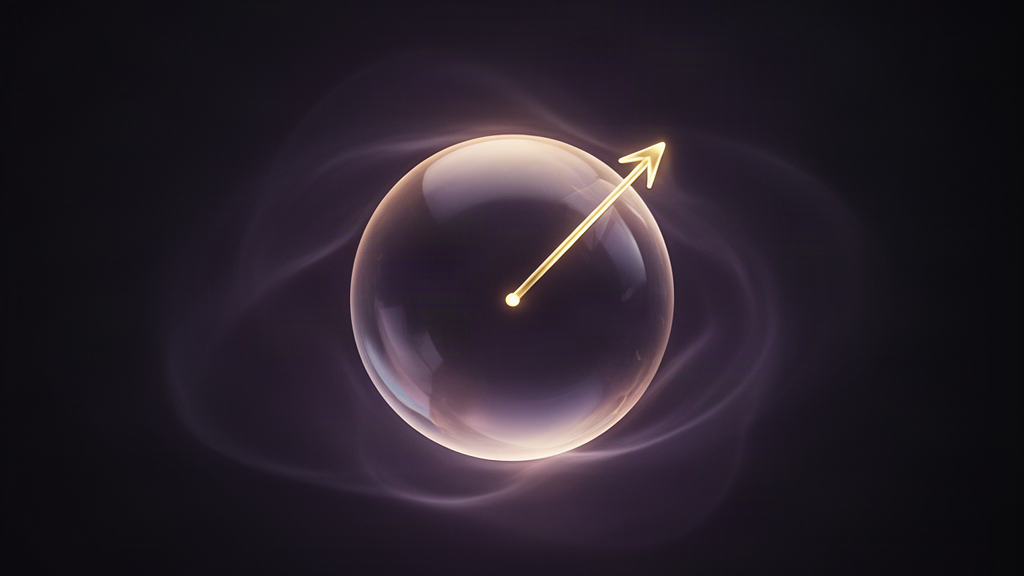
The state is continuous. α and β can take any values satisfying the constraint, so there are infinitely many possible qubit states — not two, and not "both at once", but a continuum. A single-qubit state can be pictured as a point on the surface of a sphere, the Bloch sphere, with |0⟩ and |1⟩ at the poles and every other point a valid state.
The amplitudes are complex, and that matters. Because they have phase as well as magnitude, amplitudes can cancel each other out. This is what separates quantum computing from ordinary randomness, and it is where the power actually comes from.
Measurement Destroys the State
This is the constraint that makes quantum computing hard, and it is what the popular framing omits.
When you measure a qubit, you get 0 or 1 — one classical bit. The superposition collapses; the qubit is now definitely in the state you observed. The amplitudes α and β are gone, and you never learn what they were from a single measurement.
You cannot get around this by copying the qubit first and measuring the copies. The no-cloning theorem establishes that an unknown quantum state cannot be duplicated.
So a qubit holds a rich continuous state that you fundamentally cannot read. An algorithm's job is to manipulate those amplitudes so that when you finally measure, the answer you want is overwhelmingly likely to appear.
How Many Bits Is a Qubit Worth?
This is a common and genuinely interesting question, and the answer is not what the continuous state suggests.
Describing a qubit's state precisely would require specifying two complex numbers — arbitrarily many classical bits of precision. But specifying a state and extracting information from it are different things.
Holevo's theorem establishes the limit: no more than one classical bit of information can be reliably retrieved from a single qubit. One qubit in, one bit out.
So a qubit stores an unbounded amount of information that is inaccessible, and delivers exactly one bit that is. Quantum computing's advantage does not come from cramming more data into each qubit. It comes from what happens between preparation and measurement.
Where the Advantage Actually Comes From
Entanglement
Two or more qubits can share a state that cannot be described as separate individual states. Measuring one immediately determines what the other will give, regardless of the distance between them.
A system of n qubits requires 2ⁿ complex amplitudes to describe. Fifty qubits need over a quadrillion amplitudes — which is why simulating a moderately sized quantum system on a classical computer becomes infeasible. That exponential state space is real.
The catch, again, is measurement: those 2ⁿ amplitudes exist but reading the system yields only n bits.
Interference
Because amplitudes are complex numbers, they add and cancel. A well-designed quantum algorithm arranges the computation so that amplitudes leading to wrong answers cancel out while amplitudes leading to the right answer reinforce.
This is the actual mechanism. Not "try everything in parallel and read the answer" — instead, "arrange for the wrong answers to destructively interfere so the right one dominates the probability distribution when you measure."
It also explains why quantum algorithms are rare and difficult. Constructing that interference pattern for a specific problem is hard, which is why only a handful of algorithms with meaningful speedups are known — Shor's for factoring, Grover's for unstructured search, and a set of simulation algorithms — rather than a general speedup for computation in general.
What Qubits Are Physically Made Of
There is no single answer, and the question of whether a qubit is "an atom" depends entirely on the technology.
Superconducting qubits are lithographed circuits on a chip, cooled to near absolute zero, where current flows in a loop without resistance. Not atoms — these are macroscopic circuits, visible under a microscope, that behave quantum-mechanically at low temperature. Used by IBM and Google.
Trapped ion qubits are individual charged atoms held in electromagnetic fields and manipulated with lasers. Literally atoms. Used by IonQ and Quantinuum.
Neutral atom qubits are individual uncharged atoms held by optical tweezers. Also literally atoms. Used by QuEra and Pasqal.
Photonic qubits encode information in individual particles of light — polarization or path. Not atoms, and notable for operating at room temperature.
Spin qubits use the spin of an electron or nucleus in a semiconductor, which is attractive for potential compatibility with existing chip manufacturing.
Each approach trades differently across coherence time, gate speed, error rate, connectivity, and manufacturability. None is clearly ahead on every axis, which is why several are still being pursued seriously.
Why Qubits Are Fragile
Quantum states are easily disturbed. Stray heat, vibration, electromagnetic noise, or interaction with essentially anything causes decoherence — the loss of the superposition and entanglement the computation depends on.
Coherence times are short. This is why superconducting systems sit in elaborate dilution refrigerators: the isolation is not a convenience but the central engineering challenge.
Physical Versus Logical Qubits
This distinction is what makes headline qubit counts interpretable.
A physical qubit is one actual device, and it is noisy. A logical qubit is an error-corrected qubit built from many physical ones, using quantum error correction schemes such as the surface code to detect and fix errors without measuring the state directly.
The ratio is not small. Depending on the physical error rate and the code, producing one reliable logical qubit is generally expected to require somewhere from hundreds to thousands of physical qubits.
This is why a machine advertising a large number of physical qubits may have very few logical ones — and why estimates for running Shor's algorithm against RSA-2048 call for millions of physical qubits, far beyond current systems. When comparing machines, the physical qubit count alone says little without error rates and connectivity alongside it.
Conclusion
A qubit is a two-state quantum system whose state before measurement is a continuous superposition of 0 and 1, and which yields exactly one classical bit when measured. The gap between those two facts is the whole discipline.
The framing worth discarding is that qubits let a computer try every answer at once. What they actually provide is an exponentially large state space that cannot be read directly, combined with interference that lets a carefully constructed algorithm concentrate probability onto the right answer before measurement. That is a narrower and more demanding capability, and it is why useful quantum algorithms are scarce rather than universal.
For anyone tracking the field's progress, the number worth watching is not physical qubit count but error rate and logical qubit count. A machine with a thousand noisy physical qubits and one with a hundred well-corrected logical ones are not comparable, and the second is closer to doing useful work.
Frequently Asked Questions
How many bits are in one qubit?
One, in terms of what you can retrieve. Describing a qubit's state precisely requires two complex numbers, implying unlimited classical information, but Holevo's theorem establishes that no more than one classical bit can be reliably extracted from a single qubit by measurement. The stored state is rich and inaccessible; the readable output is a single bit. Quantum advantage comes from operations performed before measurement, not from storing more data per qubit.
Is a qubit an atom?
Sometimes literally, depending on the technology. Trapped-ion qubits are individual charged atoms held in electromagnetic fields, and neutral-atom qubits are individual atoms held by optical tweezers — in both cases the qubit is an atom. Superconducting qubits, by contrast, are lithographed circuits on a chip that are macroscopic yet behave quantum-mechanically when cooled near absolute zero. Photonic qubits are individual particles of light. The common requirement is a controllable two-state quantum system, not any particular kind of matter.
How powerful is 50 qubits?
Fifty qubits is significant as a simulation threshold: describing their joint state requires 2⁵⁰ complex amplitudes, over a quadrillion values, which makes exact classical simulation impractical. That threshold is why early quantum-advantage demonstrations used systems around that size. It does not mean fifty qubits can do useful work — those are noisy physical qubits without error correction, and running algorithms such as Shor's against real cryptographic key sizes is estimated to require millions of physical qubits. Being hard to simulate and being commercially useful are different milestones.
How much does 1 qubit cost?
Qubits are not sold individually, so there is no per-qubit price. Complete quantum computers are custom-built systems whose cost is dominated by supporting infrastructure — dilution refrigerators, control electronics, laser systems — rather than by the qubits themselves. In practice most users access quantum hardware through cloud services such as IBM Quantum, Amazon Braket, or Azure Quantum, which typically bill per job or per unit of runtime, with free tiers available for small experiments on simulators and limited real hardware.
What is the difference between a physical and a logical qubit?
A physical qubit is one actual device and is noisy enough that computations of meaningful length fail. A logical qubit is an error-corrected qubit assembled from many physical qubits using schemes such as the surface code, which detect and correct errors without directly measuring the protected state. The overhead is substantial — generally expected to be hundreds to thousands of physical qubits per logical one. This is why headline physical qubit counts can be misleading, and why error rates matter as much as counts.
Does a qubit really hold 0 and 1 at the same time?
It is a rough approximation that misleads more than it helps. A qubit's state is a combination of 0 and 1 with complex amplitudes, and measuring it always gives a single definite value. Because measurement collapses the state and unknown states cannot be copied, you cannot read out both possibilities. Quantum algorithms work not by evaluating all answers and reading them, but by arranging interference so that amplitudes for wrong answers cancel and the correct one dominates when measured.
Comments (0)
No comments yet.